Posts Tagged ‘LNG’

Mar12

Dow-funded study says [LNG] prices triple with aggressive exports

by Jenny Mandel, E&E reporter

Tuesday, March 12, 2013 
 
Domestic natural gas prices could nearly triple by 2030 if high levels of exports are seen, according to a study paid for by Dow Chemical Co.
 
"If left unmonitored, high [liquefied natural gas] exports could prevail at the cost of the broader economy," the report warns.
 
A "likely" level of LNG exports of 20 billion cubic feet per day would send prices to $8.80 per million British thermal units in 2030, the analysis says, while a "high" export scenario of 35 bcf/day by that year would put them at $10.30/MMBtu. That is above the $6.30/MMBtu the study says would otherwise be seen in 2030, given what it describes as a "reasonable" demand forecast.
 
Consulting group Charles River Associates (CRA) released the study, carried out for Dow, yesterday. The analysis was commissioned to take into account a draft study of LNG exports published by the Energy Department in December and carried out by NERA Economic Consulting, as well as comments received by DOE in response to that study.
 
The Dow report was completed to inform the company's comments filed during a second round of feedback solicited on that study by DOE that wrapped up late last month (EnergyWire, Feb. 26).
 
NERA considered export scenarios with between 6 bcf/day and 12 bcf/day of exports, far less than the "likely" level reflected in CRA's assessment.
 
Dow did not directly publicize the study, though Charles River Associates issued a news release on it yesterday. A representative for the chemical company said it had no comment on its contents beyond the feedback submitted to DOE.
 
The wisdom and proper legal treatment of exporting LNG or keeping it in the United States to support domestic manufacturing and other uses have been hotly debated, and Dow has been among the loudest voices urging DOE to move slowly in approving export applications.
 
Some stakeholders in the debate have said Dow should provide analysis supporting its claims that energy-intensive manufacturers would be harmed by extensive exports, and the study responds to that argument. DOE is obliged to carefully consider comments received through the public comment process in deciding how to proceed on 18 projects currently awaiting broad export permits.
 
The analysis focuses on domestic price effects of higher LNG exports, rather than global price adjustments, and reflects announcements by manufacturing companies of "more than $90 billion" in new plants and other facilities that would, if built, consume natural gas.
 
It claims that the NERA study misrepresents the natural gas intensity of certain manufacturing segments and underestimates future demand from manufacturing, natural gas vehicles and the replacement of coal-fired electric power generation.
 
The result, CRA concluded, is an underestimate of the employment, trade balance and gross domestic product effects of expanded LNG exports.
 
"Current expectations for a low cost, gas-driven electricity economy and significant deployment of natural gas vehicles could be foregone due to LNG exports," the firm said.
 
Click here for the CRA study.
 

Feb28

Extractive Industries are Killing the Planet–Eugene Rally March 3rd

FOR IMMEDIATE RELEASE: February 27, 2013

Extractive Industries are Killing the Planet
 
Eugene, Ore.—March 3 at 1 p.m. A rally will be held in the University of Oregon EMU amphitheater proceeded by a march against the fossil fuel industry. The march is follow-up to the “End All Extraction” march on February 17, since the demands from the first march were not met.
 
The event is to coincide with the end of the Public Interest Environmental Law Conference (PIELC), which begins on February 28. Hundreds will gather and march against governments and businesses that support fossil fuels and other extractive industries.
 
“The people need to hold corporate extractors accountable since government has not,” said Jim Flynn of the Cascadia Forest Defenders, sponsors of the march.
The rally is in solidarity with local and national groups such as Idle No More, Tar Sands Blockade, and No Coal Exportation.
 
These movements include thousands of environmental and social justice activists from many varied groups such as non-governmental organizations (NGOs), first nations, minority justice groups, small businesses, labor unions and concerned citizens of all varying political backgrounds.
 
This event features a large collaboration of national and local organizations and people coming together to stand up and say “no” to tar sands extraction, “no” to the Keystone XL pipeline, “no” to coal extraction and exportation, while simultaneously saying “yes” to equality for all life, “yes” to challenging governments and businesses for sustained forms of energy and, “yes” to clean air, water and land/space for future generations to live.
 
The event will kick off with a rally that will include speeches by Tar Sands Blockade spokesperson *Ramsey Sprague*; executive director of the Civil Liberties Defense Center *Lauren Regan*; and *Sam Kopf* of the Cascadia Forest Defenders.
 
The Erb Memorial Union (EMU) amphitheater is located on the northwest side of the EMU at the University of Oregon.
 
For more information on the groups we are in solidarity with, please visit these websites:
 

Dec06

Report could boost plans for natural gas pipeline in Douglas County


December 6, 2012
 
By Don Jenkins NewsReview 
 
In a finding that may bolster the argument for building a pipeline across Douglas County, natural gas exports would boost the U.S. economy, according to a report released Wednesday.
The study, commissioned by the U.S. Department of Energy, warned there would be “winners and losers,” but concluded that overall the country would profit as foreign countries bought U.S. natural gas.
 
The DOE took no position on the study, done by NERA Economic Consulting, but said it may influence regulators considering export proposals, including the Jordan Cove Energy Project in Southern Oregon.
 
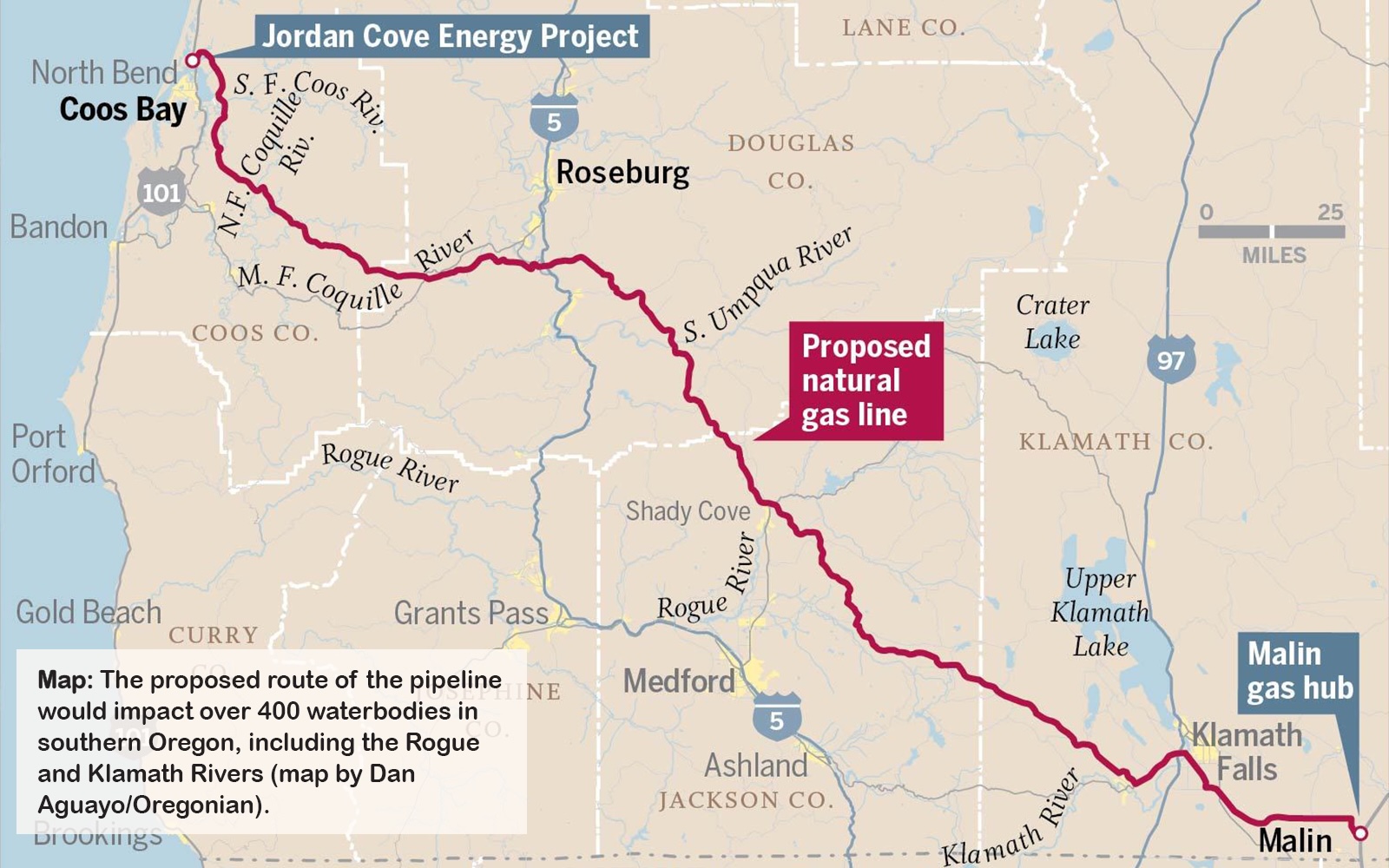
Two companies propose building a 234-mile pipeline through Douglas, Klamath, Jackson and Coos counties to transmit natural gas to a terminal at the International Port of Coos Bay.
 
Port spokeswoman Elise Hamner said today the port hoped the report will help developers get approval from the Federal Energy Regulatory Commission.
 
“This is a positive development,” she said. “It’s just an incredibly good economic impact to have a development like that here.”
 
The port previously had commissioned a study that found extensive economic benefits for Southern Oregon, including 120 permanent jobs paying an average of $82,000 a year associated with the terminal.
 
The new study takes a broader look at the economic effects of licensing some or most of the 20 active proposals in the U.S.
 
Two South County landowners opposed to the pipeline said today the new study didn’t take into account many of their concerns and focused too much on the benefits gained by natural gas developers.
 
“Obviously, this report is slanted toward big industries. Multinational corporations will profit, families won’t,” said Days Creek landowner Francis Eatherington, whose property the pipeline would cross.
 
Tenmile property owner Frank Adams said questions remain about environmental costs, the loss of his and others’ private property and the long-term effects of not retaining natural gas for domestic use.
 
“Why should we sell our children’s heritage?” he asked. “Why shouldn’t we utilize that in our own country?”
 
DOE asked for the report because of the explosion in proposals, a reflection of changing market conditions. Until early this year, the companies behind Jordan Cove, Williams Northwest Pipeline and Veresen Power proposed importing natural gas to meet U.S. demand.
 
Efforts to reach a Jordan Cove spokesman today were unsuccessful.
 
According to the study, the country would profit overall as wealth was transferred to the United States from other countries, increasing gross domestic product by as much as $47 billion in 2020. The study concludes that the more gas is exported, the greater the benefits.
 
Winners would include owners of natural gas resources, their shareholders and workers employed in producing and exporting natural gas.
 
The study, however, also confirmed earlier findings that exports would increase natural gas prices in the U.S. — by 25 percent over five years if exports increase significantly. The increase in natural gas prices would increase coal consumption, the report found.
 
The report warned that job losses would occur in energy-intensive industries and that exporting natural gas would not increase, or decrease, the total number of U.S. jobs.
 
“Impacts will not be positive for all groups in the economy,” according to the report. “Households with income solely from wages and government transfers, in particular, might not participate in these benefits.”
 
Sen. Ron Wyden, D-Ore., who has been critical of proposals to export natural gas, focused on the potential for rising energy costs in the U.S.
 
“Broadly speaking, the study appears to confirm that exports of LNG will raise the domestic price of natural gas,” according to a statement released by his office.
 
Eatherington said the study appears to have given short shrift to the effects of higher energy costs on families. Eatherington, the conservation director for Cascadia Wildlands, also criticized the report for not addressing the environmental costs of climate change or hydraulic fracking, which involves blasting shale rock with water, sand and chemicals to release gas and oil.
 
The process has increased natural gas supplies, but critics say the process pollutes groundwater and may even trigger earthquakes.
 
“Clean drinking water is an economic issue that should have been considered,” Eatherington said.
 
The report, Eatherington and Adams noted, also doesn’t address the financial impacts on landowners who would be being forced to grant right-of-way to pipelines for a small payment.
 
The DOE will take initial public comments on the study until Jan. 23. A period to reply to comments will be accepted from Jan. 25 to Feb. 25.
 
Comments may be filed by email, LNGStudy@hq.doe.gov, or mailed to U.S. Department of Energy (FE-34), Office of Natural Gas Regulatory Activities, Office of Fossil Energy, P.O. Box 44375, Washington, D.C., 20026-4375.
 
The entire report can be read here DOE study 


Aug17

Thanks too to Senator Wyden for his Message to FERC–Longer Comment Period For Pacific Connector Pipeline and Listen More to other Federal Agencies

Thank you Senator Wyden.  

Click here for copy of letter

Aug16

Rep. DeFazio Requests that FERC Increase Transparency and Extend Pipeline Comment Period

Click here to read Rep. DeFazio's letter to FERC.


Aug15

Coos Bay Gas Pipeline Puts Much at Risk–Get Engaged

Gabe Scott in Alaska

by Gabe Scott
 
Last week’s massive refinery fire in Richmond, California should serve as a wake-up call. Not that we needed another to remind us of a basic fact: oil and gas infrastructure is dangerous. When things go wrong, they go very wrong, very quickly.
 
Add this to the list of reasons why the Pacific Connector Pipeline and LNG export terminal at Coos Bay is a bad idea: it’s not safe. 
 
I’ve been participating lately in a nationwide citizen committee on pipeline safety, put together by the Pipeline Safety Trust (http://www.pstrust.org/initiatives_programs/New-Voices-Project/). The opportunity to share information and learn from activists, landowners, industry and regulators has been astounding, and has opened my eyes to the downsides of natural gas infrastructure that, as an environmentalist, I admit I hadn’t given enough thought to. 
 
Here’s the thing about gas pipelines and LNG plants — they blow up.  They blow up a lot. They blow up big. And the people who you might expect would put safety first, don’t. 
 
Liquefied Natural Gas, like natural gas, is highly flammable. When spilled, it can easily go “boom.” As a matter of fact, because of its physical properties, spilled LNG also goes “boom” when it comes in contact with water, a phenomenon called “rapid phase transition” (see below video). In 2004, an explosion at an Algerian LNG liquefaction facility killed 27.
 
 
The Pipeline phase of the project would transmit natural gas through a 36” diameter transmission pipeline. Gas pipeline explosions can be massively destructive. In 1994, a 36-inch gas distribution line in Edison, New Jersey broke, threw rocks and debris more than 800 feet, and exploded in a blaze over 400 feet high— hot enough to ignite and burn several nearby apartment buildings. Last year, five were killed in Allentown, PA when a gas explosion flattened a rowhouse neighborhood, sending flames hundreds of feet into the air. It took workers another five hours to figure out how to shut off the gas flow. 
 

One of our concerns with the Pacific Connector pipeline is that the safety regulations are even weaker in rural areas than in populated neighborhoods, so families living along the Pacific Connector pipeline are at even greater risk. Getting blown up isn’t usually on our safety list when hiking and camping in wild lands, but the pipeline would make that risk real. In 2000, 12 campers were killed by a gas pipeline explosion near Carlsbad, NM.
 
These aren’t isolated examples. Leaks and explosions on this sort of pipeline are disturbingly common. In an average year, looking only at gas transmission pipelines (which is what Williams proposes), there are 113 reported incidents causing 2 fatalities, eleven injuries, and over $132 million in property damage. (Source: PHMSA http://primis.phmsa.dot.gov/comm/reports/safety/AllPSI.html?nocache=1948#_ngtrans)
 
Oil and gas companies are fond of touting a “safety first” mentality. This is not just propaganda spin. Give credit where it’s due: they really do devote immense energy to safety, and their engineering know-how is breathtaking.


The trouble is there are so many things that can go wrong. Pipes corrode. Valves leak and get stuck. Unknowing construction workers dig into unmarked pipelines. People make mistakes. Equipment fails. Earthquakes and floods happen. There are a thousand and one things that can go wrong, any one of which can kill you. 
 
While one should give the industry credit for taking the engineering aspects of safety very seriously, their record on risk management and public process is dastardly. They are secretive, competitive, and selfish. They make the same “mistakes,” over and over again. 
 
After the 2005 explosion at BP’s Texas City refinery, which killed fifteen, a blue-ribbon panel was formed to investigate, headed by former Secretary of State James Baker. The panel’s recommendations centered on what they termed a “safety culture” and “process safety.” Details quickly get complicated, but the underlying notion is simple: when trying to make complex industrial systems safe, you need to analyze and address the whole ball of wax, not just this and that component. 
 
After the 2010 explosion of BP’s Deepwater Horizon, another blue-ribbon panel was formed. Their conclusions were damning. Process safety and safety culture were still not being implemented. And, the Commission found, these problems were not unique to BP, but endemic in the oil & gas industry. 
 
As we look at the Pacific Connector Pipeline and LNG terminal, familiar warning signs are everywhere. I’ll leave you with just one example. As Cascadia’s staff digs into the details, we have hit a roadblock. The company won’t share its maps, even with landowners along the proposed route. Their excuse is the preposterous claim that exact locations of the proposed line must be kept secret, to keep it out of the hands of would-be terrorists. 
 
That’s hogwash. Fundamental to pipeline safety and planning is everyone needs to know where, exactly, the line is. This information is needed whenever anyone digs a hole, whenever there is a leak that needs to be investigated, whenever a wildfire fighting crew is planning their attack on a blaze. You need to plan to avoid flooding streams, landslide areas, and places planned for other kinds of construction. You need to site the line to allow regular access for maintenance and surveillance. 
 
Terrorism IS a real fear. But hiding maps from landowners does nothing to prevent it. Far from requiring gas pipeline locations be kept secret (as if that were even possible), federal regulations require gas pipelines be clearly marked with bright yellow signs. 
 
The supposed security rationale is so absurd, so wrong-headed, that it calls into question the company’s basic trustworthiness. It suggests that Williams views this as their project, none of anyone’s business. That’s a pretty arrogant line to take when you’re forcibly appropriating other people’s private land through eminent domain. 
 
Far from putting safety first, indications are Williams is putting it’s own pocketbook first, last, and in the middle. That’s not just selfish. It’s also very, very dangerous. 
 
Please join Cascadia Wildlands in sending the Federal Energy Regulatory Commission a message on the Pacific Connector Pipeline.  Click here to comment and do not be concerned when you get a message from FERC that your comment may not be considered.  We will make sure that your support of our concerns and any additional comments you provide will go to the appropriate place and be heard.  They will get our collective message.

Aug13

Bob Ferris on the Radio in Coos Bay–of Timber, Coal, LNG, and Jobs


Bob Ferris interview on the Mark McKelvey Show on July 10, 2012.  He and Mark talk about timber, coal, LNG and jobs in Coos Bay.  The 40-minute interview starts at about minute 11 and can be heard by clicking here.


Jul07

The Carbon Curtain Coalition

Naomi Klein in her book Shock Doctrine laid out a recipe for our destruction: Take a real or manufactured crisis, add economic interests with political clout, and apply both towards a bend-over-backwards Congress and a panicked public.  The end result being economic interests allowed to cause us more harm and make even more money in the process.  And nowhere is this doctrine more in evidence than the current efforts to make our beloved Cascadia the carbon export capital of North America.

 
In our set of carbon scenarios the extractive industries—coal, oil, gas, and timber—are using the current economic and energy crises to get sweetheart deals to make their economic schemes work.  It does not take a Nobel Prize winning economist to understand that for raw natural resources from North America to be competitive with their Asian equivalents in Asian markets, our governments have to sell them for less than they are actually worth.  (If you want to delve into the economic nuts and bolts of this I would suggest skimming The World's Greatest Coal Arbitrage: China's Coal Import Behavior and Implications for the Global Coal Market by Richard Morse and Gang He from Stanford—their basic messages being that China has coal and they only buy it from us because we are willing to sell it cheaply.)
 
But a low return from deeply discounting our shared assets is only one of the impacts.  All of the export schemes also endanger our health, safety, and quality of life and compromise wildlands and wildlife.  Take the Coos Bay LNG boondoggle, for example.  To make this beast work we not only have to sell our future energy security cheaply but we also must sacrifice the water quality in areas of the Rockies where the natural gas will be extracted by fracking; condemn private land and further fragment public lands with 320 miles of pipeline; and put an entire community at grave risk with the siting of the explosive LNG terminal in the flight path of a local airport.  
 
When looked at in totality these schemes begin to look like a demented game of Mad Libs where you simply substitute the offending carbon commodity—e.g., coal, tar sands, LNG, timber, shale oil–and then fill in the blanks regarding human, community, and ecosystem impacts.  There would likely also be an irony blank where the wonder of private enterprise and job creation come face-to-face with the reality of the massive public subsidies and investments required to enable these projects and the job losses in the manufacturing sectors associated with the supplying of underpriced raw materials to a competing economy.
 
While we are on the topics of private investment and job creation, two issues should arise.  First, private is an interesting term when looking at funding coming from investment banks such as Goldman Sachs—in the case of the Cherry Point coal terminal—just how “private” is that capital from an institution holding broad deposits and still making profits because of federal intervention and tax-payer investment.  And as for job creation, the extractive industries are really not very effective at translating capital in to jobs or even delivering on what relatively scant jobs they promise to create.
 
To those watching and studying this collective phenomenon, it really feels like we are being attacked on all fronts at once.  That is often demoralizing unless you start to also see the little dots of resistance emerging from Alaska to California and from Washington to Montana.  It is good to see the coal folks working together both in the US and Canada.  The same is true for the oil pipeline people and LNG opponents too.  But we really need to all understand that this collective rush to ship needs to be met with collective and responsive opposition.  
 

I have talked to many about the efficacy of forming what I have called a Carbon Curtain Coalition that coordinates and enables all of these individual and regional initiatives.  The Carbon Curtain Coalition’s mission would be a simple one: Oppose carbon exports from ports in western North America.  Whether or not this coalition is a good idea or if it gets formed, we should all act like it exists.  We should all watch this important set of issues and be ready to support any and all efforts.  We should all have instant membership by virtue of the fact that these projects will fundamentally change our world for generations to come.
 
The Carbon Curtain Coalition’s message to politicians would be: If you really want a crisis to take action on, how about the one that is frying Americans to death in the East?  Or how about the crisis that is acidifying our oceans?  Or what about the one that is likely influencing the severity of storms and property losses?  This list goes on and on, but all of these tendrils lead back to carbon in some way.  So get involved and make some noise.
 
 
Upcoming Events in Eugene:
 
July 9—
Eugene City Council Meeting  Come support a No Coal Trains resolution
 
July 16—
 
Places to Start:
 
Power Past Coal (look for your local group on the list of partners
 
Our Take:


we like it wild. Follow us Facebook Twiter RSS